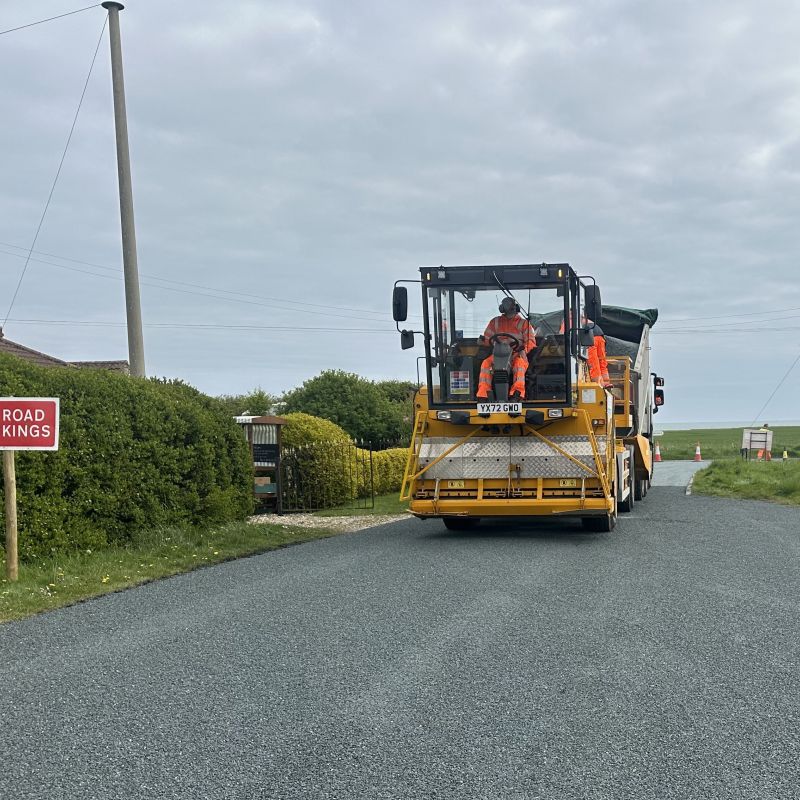
Road improvements worth £3.5m are due to be carried out in the East Riding this spring and summer to help protect against potholes and other damage.
East Riding of Yorkshire Council is investing the money in its annual road surface dressing programme, which is scheduled to begin on Wednesday 22nd April and is expected to take 16 weeks to complete.
The surface dressing forms a major part of the council’s planned highway maintenance programme.
The scheme will cover all types of roads, from A roads to unclassified roads, and will see 166 sections of the network upgraded – the equivalent to 68 miles.
Around 700,000 square metres of stone chippings will be laid on road surfaces during the operation, which is comparable to surfacing a continuous route from Beverley to Hartlepool.
Surface dressing is a fast and cost-effective method of repairing, preserving and prolonging the lifespan of a road, and is carried out by the council’s own highways maintenance team.
The work consists of applying hot, adhesive bitumen to the road, covering it with chippings, and then rolling them in.
Afterwards, road sweepers clear away any loose chippings after a few days. New road markings are then put down as quickly as possible.
The process actively reduces the risk of potholes forming, as it seals the road and prevents water from entering and damaging the surface. It also significantly improves skid resistance for vehicles.
The programme process is carried out during the spring and summer months as it requires warmer temperatures for the bitumen and chippings to bond effectively.
Councillor Paul West, the council’s cabinet member for environment and transport, said: “We really appreciate drivers and local residents for bearing with us over the next few months while our crews carry out this essential work to improve our roads.
“Surface dressing is an extremely important part of our annual maintenance programme because it helps to protect these roads from potholes and other damage.”
Residents and motorists notified
During and after the work, temporary 20mph speed limits will be in force on the treated roads to reduce the risk of vehicles skidding on loose chippings and to minimise the likelihood of stones being dislodged and flicked up by passing traffic.
These restrictions will be removed once the new road markings have been installed.
Disruption to traffic will be kept to a minimum, however drivers are asked to respect the 20mph speed limit, in place to protect both the travelling public and the council’s workforce.
Residents and drivers will be informed before the works begin. A leaflet will be sent to all residents who may be affected by the works, and advance warning signs will be installed on the roads in advance.
Loose chippings are recycled
After the surfacing dressing is complete, any loose stone chippings left behind won’t go to waste.
Mechanical road sweepers are used to collect all the loose chippings, and they are then stored.
Every two years the council hires a giant industrial washing and grading machine to clean all the loose chippings so they can be recycled and reused on the roads the following year.
The process recycles more than 7,000 tonnes of chippings and saves around £60,000 of council tax payers’ money.